
Uma Schröder · 25 September 2026
Shifting Focus to Semantic Relevance in Content Structures for Niche Web Environments
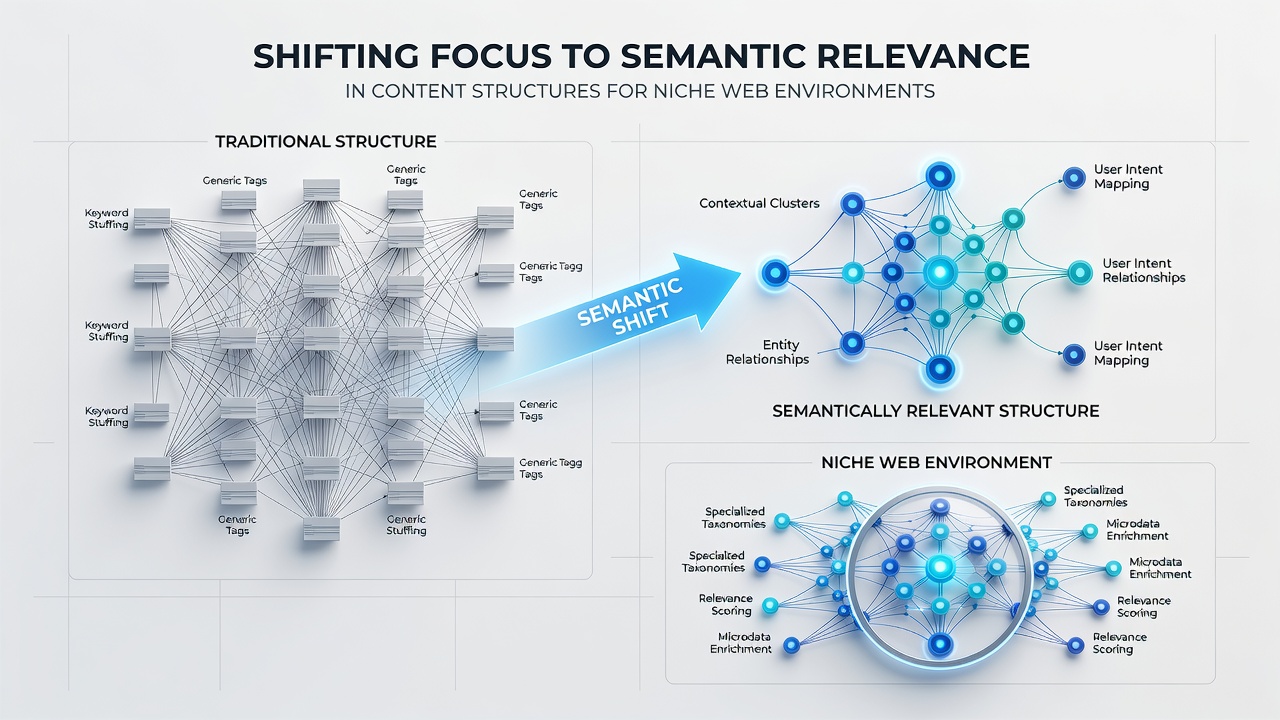
Web environments serving niche audiences have begun reorganizing their content architectures around semantic relevance rather than isolated keyword placement, and this adjustment aligns with broader changes in how retrieval systems parse meaning across specialized domains. Researchers tracking these developments note that niche platforms such as industry forums, academic repositories, and hobbyist networks now embed entity relationships and contextual signals directly into page hierarchies to improve retrieval accuracy for targeted queries.
From Surface Keywords to Meaning-Based Architectures
Early content structures on niche sites relied heavily on term frequency and basic metadata, yet retrieval engines have since incorporated natural language processing layers that evaluate topical coherence and entity connections. Data from multiple studies shows that pages organized around semantic clusters maintain higher visibility in specialized result sets because algorithms can map user intent to related concepts without exact phrase matches. Observers note that this transition requires content creators to define core entities first, then build supporting sections that reinforce relationships between those entities through consistent internal linking and structured data markup.
Structural Adjustments in Specialized Platforms
Niche web environments often feature constrained audiences and limited crawl budgets, which makes efficient semantic organization particularly valuable. Site architects achieve this by layering schema.org vocabulary into templates, grouping related subtopics under parent entities, and using clear heading hierarchies that signal topical depth rather than simple keyword repetition. Figures from industry reports indicate that sites adopting these patterns experience steadier indexing rates because crawlers can infer context from the overall graph rather than scanning for repeated terms. One documented approach involves creating hub pages that define primary concepts while leaf pages expand on attributes and examples, thereby forming a navigable knowledge structure that retrieval systems recognize as authoritative within the niche.
Integration of External Data Signals
Developers working on niche platforms frequently incorporate external knowledge bases to strengthen semantic signals, pulling structured information from sources that supply consistent entity definitions. This practice helps smaller sites compete in result pages where broader domains dominate through volume alone. According to documentation from the World Wide Web Consortium, standardized vocabularies enable machines to understand relationships across disparate sites, which proves especially useful when niche content must surface alongside mainstream material. Implementation typically begins with identifying high-value entities relevant to the audience, followed by consistent application of properties such as “about,” “mentions,” and “relatedLink” across all templates.
Observed Patterns Through September 2026
By September 2026, multiple retrieval systems had rolled out incremental updates emphasizing semantic graph alignment, prompting niche operators to audit their content hierarchies for entity completeness. Reports compiled by research groups at institutions including Stanford University reveal that platforms maintaining dense internal semantic connections retained visibility more effectively during these rollouts. Those managing specialized environments have responded by auditing legacy pages for missing contextual markup, rewriting thin sections to strengthen topical coverage, and monitoring how changes in one content cluster affect retrieval of related clusters. The pattern shows that sites treating semantic relevance as an ongoing maintenance task rather than a one-time project achieve more stable performance across algorithm iterations.
Practical Implementation Steps
Teams begin by mapping the core entities that define their niche, then constructing content trees where each branch reinforces the central concepts through examples, comparisons, and supporting data. Structured data is applied uniformly so that crawlers can extract the same relationship types regardless of page type. Internal anchor text shifts from generic phrases to descriptive references that reflect entity attributes, which strengthens the overall graph without introducing noise. Monitoring tools track how changes propagate through indexing logs, allowing adjustments before visibility fluctuations widen. This methodical process has been documented across multiple case examinations conducted by academic and industry analysts, confirming measurable gains in relevance scoring for tightly focused queries.
Conclusion
Niche web environments continue adapting content structures to prioritize semantic relevance, driven by retrieval systems that evaluate meaning through entity relationships and contextual coherence. The documented shift involves deliberate architectural choices around schema application, content clustering, and consistent entity mapping, with measurable effects observed through September 2026 and beyond. Organizations that maintain these practices position their specialized content for sustained discoverability within competitive result landscapes.